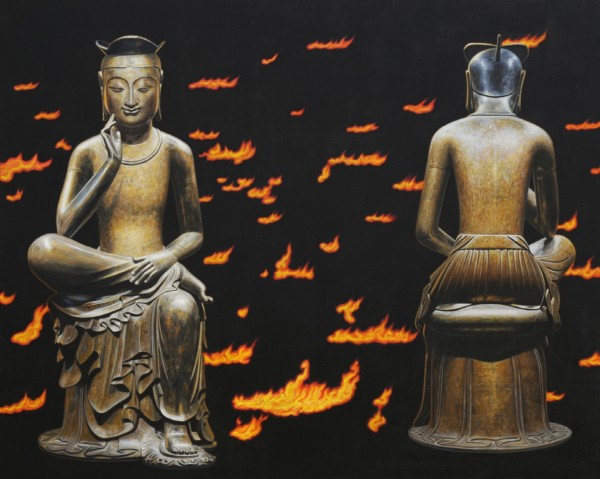
Lee Jong-gu, Contemplation_Buddha 3 (또는 사유_불 3), 2026
Acrylic on canvas, 180 x 180 cm
Hakgojae Gallery is pleased to host Contemplation: 思惟, a highly anticipated solo exhibition by seminal Korean artist Lee Jong-gu, running from May 20 to June 20, 2026.
Centered on the iconic form of the Pensive Bodhisattva, this exhibition establishes a taut tension between contemporary reality and the human modes of perceiving it.
In a world recently marked by isolation, Lee shifts his outward gaze inward, proposing a devotional realism that critically reflects upon and heals the human condition.
Building on the core principles of the Minjung (people's) populist art movement that he has championed since the 1980s, Lee expands his artistic horizon to investigate the intrinsic nature and universality of human existence.
The showcase offers a focused illumination of an artistic oeuvre that transcends localized socio-political agendas to attain a universal spirituality rooted in life and peace.
As a foundational figure in South Korea's social realism movement, Lee has spent over four decades exploring the realities of agrarian life and the rural working class.
His monumental portraits of farmers, painted directly onto discarded government-issued rice sacks, threw a sharp light on the communities marginalized by rapid industrialization and urbanization, visually codifying the structural contradictions of modern Korean society.
His paintings have always done more than merely replicate rural sentimentality; they have served as a faithful archive of contemporary social upheavals.
However, having recently navigated the profound isolation of the global pandemic, an acute awareness of mortality, and the life transition of university retirement, Lee's practice has shifted toward a deeply ontological path.
The silence discovered during extensive walking meditations and temple pilgrimages provided the catalyst to re-examine life and existence, redirecting his historical focus on external struggles toward the internal geography of his own being.
Confronting the National Museum of Korea's renowned Room of Quiet Contemplation, Lee discovered in the Pensive Bodhisattva a profound attitude of looking at the cosmos through stillness, transcending its specific religious symbolism.
This core exhibition concept, defined as the contemplation of the body, refuses to remain a detached, abstract meditation. Instead, it directly projects the existential realities of human physical experience, including illness, aging, walking, and breathing.
By juxtaposing the sublime silhouette of the Buddhist icon alongside secular, everyday landscapes, Lee paints the Buddhist philosophy of Non-duality (不二), illustrating the profound insight that life and death, suffering and peace, humanity and nature are not separate entities but interconnected currents in a continuous cycle.
The visual architecture of his canvases reinforces this philosophical stance, pairing the serene, meditative Bodhisattva with turbulent waves, licking flames, ailing bodies, and dense crowds to generate a powerful visual friction.
Here, the statue functions less as a transcendent deity and more as the eye of contemplation itself, quietly bearing witness to chaotic reality.
Lee Jong-gu, Contemplation_Buddha, 2025
Acrylic on canvas, 130 x 162 cm
By aligning the sacred form of the Buddha with the tactile materiality of the human flesh, Lee demonstrates that the spiritual and the physical, the sacred and the profane, are ultimately indivisible components of a singular reality.
While the titles of his new works, such as Mu-Mu-Myeong (No Ignorance), Bul-I (Non-Duality), Ye-To (Defiled Land), and Hang-Ma-Chok-Ji (Bhumi-Sparsha), utilize classical Buddhist vocabulary, they do not merely illustrate specific religious doctrines.
Instead, Lee summons these ancient concepts over contemporary landscapes marked by war, natural disasters, systemic hatred, and institutional conflict, questioning the existential state of humanity within a chaotic modern era.
Rather than pointing toward explicit current events, he evokes systemic anxiety and violence through refined metaphor.
The artist carefully expels emotional excess and dramatic narratives from his work, maintaining a strict distance and an intentional silence.
This disciplined restraint invites viewers to encounter each piece within the quiet sanctuary of their own interior thoughts.
Ultimately, Contemplation: 思惟 illuminates the critical juncture where Lee Jong-gu’s historical dedication to social realism gracefully expands into an investigation of universal existence.
If his early career was defined by a fierce and relentless documentation of systemic injustice, his recent practice shifts its center of gravity toward a profound inquiry into the origin of life itself.
His paintings have moved past the surface representation of historical events, entering a metaphysical arena that interrogates how humans perceive and remember the world.

Lee Jong-gu, Non-Duality (Mu-Mu-Myeong), 2025
Acrylic on canvas, 130 x 130 cm
Under the silent, watchful gaze of the Pensive Bodhisattva, the audience is brought face-to-face with a landscape where body mortality, transient traces, and alternating currents of light and shadow collide.
Within this tense, contemplative space, the artist presents a vital and enduring question for the modern era, asking what we are currently witnessing and what kind of world we are choosing to inhabit.
Born in Seosan, South Chungcheong Province, Lee Jong-gu graduated with a Bachelor of Fine Arts from Chung-Ang University before earning his Master’s degree in Art Education from Inha University. He later served as a Professor of Western Painting at Chung-Ang University and as the CEO of the Incheon Foundation for Arts and Culture.
His distinguished exhibition history includes major solo presentations at Hakgojae Gallery, the Incheon Art Platform, and his landmark Artist of the Year exhibition at the National Museum of Modern and Contemporary Art (MMCA) in Gwacheon in 2005.
His work has been featured in vital institutional group exhibitions, such as a recent showcase at the Seoul Museum of Art, a major project for the Chungnam Museum of Art, and the historic exhibition Lineages: Korean Art at The Met at The Metropolitan Museum of Art in New York in 2024.
A recipient of the Gana Art Prize and the Woohyeon Art Prize, Lee’s work is held in the permanent public collections of South Korea's foremost cultural institutions, including the National Museum of Modern and Contemporary Art, the Seoul Museum of Art, and the Jeju Museum of Art, cementing his position as a crucial pillar of Korean contemporary art history.

Lee Jong-gu, Mu-Mu-Myeong 5 (또는 무무명 5), 2026
Acrylic on canvas, 36 x 24 cm