Bright Moon, 2024-26, 30 x 25cm, oil and wax on canvas
SunGallery is delighted to present the first solo exhibition in Korea by Sebastián Espejo, an acclaimed Chilean contemporary artist currently based in London.
Titled Bright Moon, the exhibition features eighteen new works that take their conceptual point of departure from Cheongsanni byeokgyesu ya (Deep Blue Stream in the Green Mountains), a celebrated traditional sijo poem penned by the historical Korean poet Hwang Jini.
Espejo’s paintings internalize the 28-day lunar cycle of waxing and waning, capturing the fleeting moments when moonlight briefly saturates a given space and translating this phenomenon into an intricate relationship between form and ground.
Through this painterly exploration, the artist investigates a subtle equilibrium between transience and permanence, memory and active depiction, allowing the canvas to mediate between diverse environmental contexts and classical Korean literary sensibilities.
Espejo’s practice has already garnered significant acclaim within the international contemporary art scene, underscored by consecutive curatorial engagement from two distinct directors of the São Paulo Biennial—a rare distinction for a contemporary Latin American artist.
His recent London exhibition, Lustre, was conceived as a rich visual dialogue with the legacy of Pierre Bonnard and featured a catalogue essay by Luis Pérez-Oramas, the Artistic Director of the 30th São Paulo Biennial.
His subsequent artistic endeavors have been supported by contributions from Gabriel Pérez-Barreiro, the curator of the 33rd São Paulo Biennial.
Following his presentation in Seoul, Espejo's global momentum will carry through major international milestones, including a presence at Frieze New York, followed by highly anticipated solo exhibitions at Ingleby Gallery in Edinburgh and Selma Feriani Gallery in Tunisia.
The works assembled for Bright Moon highlight Espejo's evolving visual vocabulary, with a segment of the collection utilizing fields of shadow and darkness to evoke the gentle breath of moonlight and the physical passage of time within the gallery space.
By filtering his cross-cultural perspectives through the structural and emotional framework of traditional Korean poetry, the artist expands his practice into uncharted formal terrains.
SunGallery invites institutions, collectors, and the public to engage with this nuanced body of work, which bridges international modernism with historic Korean philosophy to offer a deeply contemplative, poetic, and enriching spatial experience.
The Stilled Instant: Sebastián Espejo’s Metaphysical Interventions in Contemporary Still Life
Sebastián Espejo’s paintings invite stylistic comparisons with both modern and historical masters, yet his true artistic lineage resides in the quiet, contemplative traditions of the still life.
While the domestic intimacy and pastel-lit surfaces of Post-Impressionist masters like Pierre Bonnard and Édouard Vuillard echo through his technique and atmospheric mood, a sharper connection emerges with the self-taught eighteenth-century French painter Jean Siméon Chardin. Chardin, celebrated for his pellucid still-lifes and quotidian domestic interiors, drew heavily upon the seventeenth-century Dutch pronkstilleven—the jewel-like, meticulously arranged compositions of Clara Peeters, Willem Claesz Heda, and Pieter Claesz that frequently carried symbolic, eschatological references to mortality and the inexorable passage of time.
These historical works were defined by a profound stillness, a deep reverence for objects, and an acute awareness of transience.
Espejo is not a traditional still-life painter in the academic sense, but he operates as a thief of moments, capturing fleeting instances with a precision that suspends time and imbues his imagery with a quiet, anticipatory glow.
Through his examinations of nature and objects, Espejo unfolds temporality into a layered space, drawing viewers into a heightened awareness of the present moment while echoing the meditative contemplation of past masters, ultimately bridging the symbolic rigor of the Dutch golden age, Chardin’s domestic meditations, and a contemporary sensibility that celebrates both stillness and the passage of time.

Persimmon
2025-26
59.5 x 42cm
oil on wood
If we look further into this historical lineage, the narrative moves from Chardin back to Bonnard, whose loving domestic vignettes of his wife, Marthe de Méligny, set within intimate interiors and rendered through saturated color and a flirtation with Japanism, translate seamlessly into Espejo’s aesthetic.
This lineage also encompasses the precise, almost factual still-lifes of Giorgio Morandi, whose tightly packed arrangements of bottles and jars on tabletops draw an immediate structural connection to Espejo’s practice.
Within the receding forms of Espejo’s canvases lie the many hidden forces of nature, functioning much like John Keats's poetic description of a Grecian urn as a silent historian expressing a flowery tale sweeter than rhyme.
In Espejo’s work, time is seemingly arrested, lending his imagery a warm, aureate glow that hints at narrative events occurring just beyond the frame.
His paintings capture fleeting moments with such precision and care that each object, figure, or scene feels charged with significance, creating a delicate foreshadowing that leaves the viewer in a state of expectation, dwelling in the quiet tension between presence and anticipation.
Through this method, ordinary domestic interiors and natural objects are transformed into profound meditations on temporality.
The Asian philosophical and aesthetic influences in Espejo’s art are equally essential to his practice.
His work resonates deeply with the aesthetic delight in imperfection encapsulated in the Japanese notion of wabi-sabi, an appreciation of irregularity that manifests historically in the singular Korean white moon jar, Buncheong ware, Chinese Tang dynasty pottery, and Japanese Raku ware used in the tea ceremony.
Espejo explicitly references the moon in his exhibition, recalling how the great Chinese poet Li Bai marveled at its reflection in a lake, while the principles of freedom achieved through rigorous routine, self-discipline, and the daily implementation of the Dao resonate as clear influences on his art.
Another vital facet uniting Western still-life thinking and Zen Buddhist precepts is the immateriality of the object—a profound existentialism that questions what we perceive.
In the Western canon, this is revealed through the memento mori, while in Asia it manifests in actions stripped of all extraneousness.
Espejo works with economic and essential means, achieving a cohesive gestalt without unduly expending energy.
The roundness of form, which in Asian culture signifies family togetherness and is epitomized by the circular mooncakes of the Lunar New Year, appears throughout Espejo’s paintings as a bridge between cultural symbolism and the essence of true reality.
Furthermore, Aristotle’s definition of the sublunar world, which emphasizes growth, decay, corruption, and change, finds a companion in the appreciation of Chinese lingbi and taihu rocks, which are celebrated for their sonority, cavernous voids, and slow-changing appearance over time. In both cases, the world is valued not for absolute perfection, but for the temporal, mutable, and experiential qualities that reveal the dynamics of natural processes.
Historically, small lingbi rocks placed precisely on carved black zitan wood stands were considered essential accoutrements of the scholar’s desk, forming a kind of literati still life in which natural form, materiality, and spatial arrangement were carefully balanced.
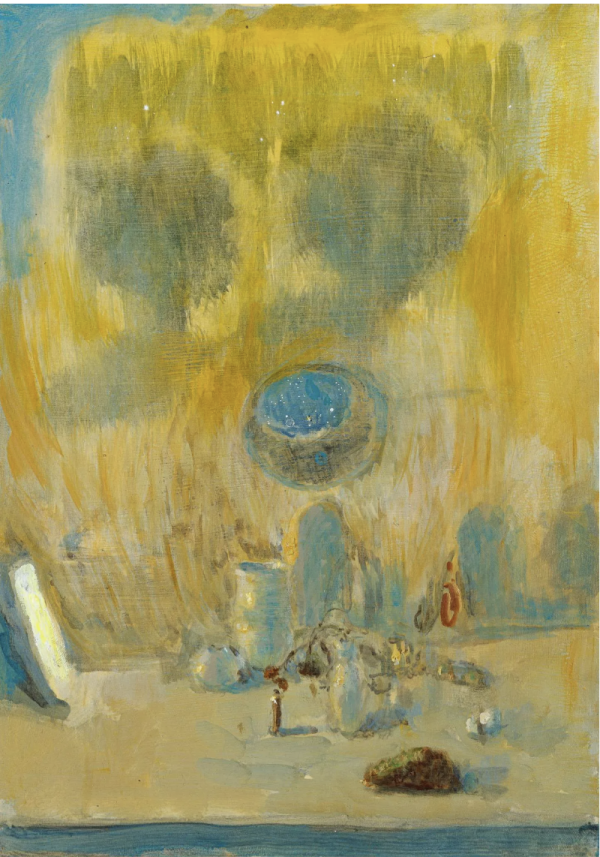
Yellow planetarium
2000
59,5 x 42cm
oil and marble dust on wood
Espejo’s seasonal images, such as January and June, employ colors that evoke the exact character of each month—marine blue for the winter chill and a golden luster for the warmth of summer—recalling the sensibilities of Eric Rohmer’s Contes des Quatre Saisons and its cinematic, tonal evocation of the shifting moods of human life. His art is fundamentally about sense and sensibility, prioritizing the immediacy of color and shape and its fleeting effect on the human psyche, yet his work possesses a temporal, film-like continuity that seems to defy the moment, inviting the viewer to experience the flow of seasons and human perception as a continuous, layered whole.
In compositions such as Persimmon, Yellow Planetarium, and Old Cherry Blossom, the touch of nature’s colors on inanimate objects conveys more than surface beauty; it suggests a compression of the distance between time and space, giving his paintings a subtly quantum quality that resonates with existential thought.
Color absorbed into the objects transforms the moment into a layered continuum, where moments are spun into hours and hours into years within a single pregnant instant, evoking the eternal in the everyday. In Old Cherry Blossom, the object becomes space and space becomes the object, while a rosy glow adds a sensual dimension.
This careful orchestration of color and spatial placement aligns Espejo with Chardin, who was himself influenced by Pieter de Hooch’s interiors, and Johannes Vermeer, whose stippled, almost impressionist color vibrates and resounds. Central to all of this is Espejo’s mastery of positioning objects, moments, and time itself, revealing that the greatest art lies in creating an eternal moment, and that a stilled life best illuminates the truth.
This profound existential tension is further explored in La Sombra del Verano, where the umbra aligns the season with chiaroscuro, emphasizing the shadow over the object that casts it.
The tree itself is absent, yet something deeply existential lingers in this suspended moment, leaving an imprint much like the perpetual anticipation of an unarrived Godot.
Footprints leave traces that record the passage of time and motion, creating an equipoise in Espejo’s work born from the delicate balance of the present and the absent. This emotive reflection on the ultimate human experience of loss is mirrored in Ramo y Escena, where the vase extenuates its presence, conveying through the interplay of object and void the coexistence of presence and absence in a fourth dimension.
We intuitively understand that absence is merely another form of presence, a concept that mirrors the solitude and emotional absence experienced by the Modernist Korean poet Gi Hyeong-do in his poem Empty House, where the loss of love forces an enclosure into an inner life from which a more profound freedom ultimately emerges.
Conversely, Floods and Moon and the River construct dual narratives, juxtaposing static, glacial foreground objects against painted riverine landscapes.
The solitary boat in Moon and the River lends the work an Asian aesthetic, while the animated brush marks across the backgrounds imbue the scenes with gestural expressiveness, demonstrating a subliminal debt to Asian compositional traditions. In contrast, Mariana Trench and Punto Fijo are among the most abstract works in the exhibition, abandoning the polarity of object and space to present instead a pure time-space continuum.
Here, color resonates and rebounds to create dense, life-affirming layers that the viewer must navigate.
Departures from Espejo’s familiar format appear in Ten and Small White Light, which resemble landscape études. Small White Light is a panoramic, beautifully measured piece that evokes a literal sea of emotions, while Ten depicts flowers piercing radiant light and color in a Symbolist fashion.
Ultimately, Espejo's paintings fill the void with meaning, presence, and consequence. Through the sophisticated interplay of object, color, atmosphere, and abstraction, Espejo transforms ordinary elements into extraordinary experiences, demonstrating some of the most poignant examples of contemporary philosophical art.

Small White Light
2024-26
25 x 20cm
oil, pills, marble dust,wax on canvas