The exhibition Shatter Zone is held at the Bezalel Gallery for Contemporary Art, located at Herzl 119, Tel Aviv-Yafo, from December 11, 2025, to February 21, 2026.
Curated by Hadas Kedar, the exhibition re-examines geographical and cultural landscapes that exist on the periphery of power.
The title is borrowed from a geological term for fractured rock formations to explore territories where identities and histories have been fissured by displacement and political upheaval.
The Negev desert is presented as a site of deep stratification where ancient civilizations intersect with modern struggles over land rights and industrialization.
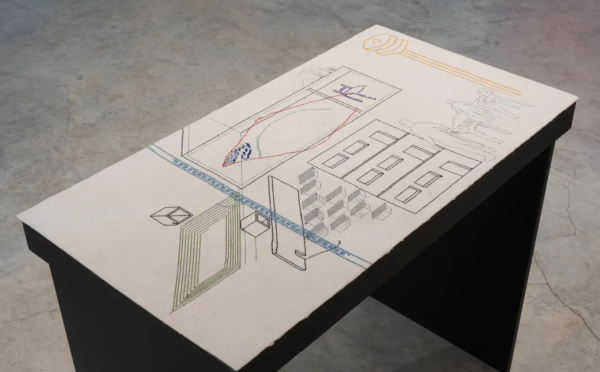
Lobna Sana, an architect and artist born in 1998, explores the psychological burden of living under constant surveillance in the Naqab. Her 2021 work, Surveillance, repurposes traditional Bedouin embroidery to document the "criminalization" of dwelling by replacing sacred imagery with observation towers and prison cells.
Her practice serves as an act of resistance by seeking architectural methods to evade demolition cameras. Khader Oshah, born in Gaza in 1966, presents a ceramic series titled Painting Papers from 2010 that functions as a physical extension of the desert.
He treats the cratered earth as both a studio and a collaborator to compose scenes reflecting Arab Bedouin customs and rituals.
These clay sculptures trace a lineage of desert life, including pastoralism and trade routes, acting as a living testament to rooted desert intelligence. Netally Schlosser, born in Haifa in 1979, merges prehistoric archaeology with digital technology in her sculptural series including Asian West, Darbuka, and Desert Varnish.
She uses rock shards found in the Negev as a starting point, scanning and digitally mirroring them to create symmetrical 3D-printed forms.
Her work embraces fragmentation as a contemporary condition and explores how computational analysis can unlock material memories from the natural environment.
Ezra Padwa, born in Santa Fe in 1976, investigates ancient systems of time and space from the Nile Valley and central Mexico.
His 2024 work, Kalendario 5/16, was fabricated in collaboration with Zapotec weavers using natural dyes to re-encode a 16th-century calendar into color-block scripts.
Padwa’s fiber and sculptural works remind viewers that modern digital networks are deeply rooted in the ancient traditions of text and textiles.
The gallery is open to the public on Tuesday and Wednesday from 11:00 to 14:00, on Thursday from 12:00 to 18:00, and on Friday and Saturday from 11:00 to 14:00.