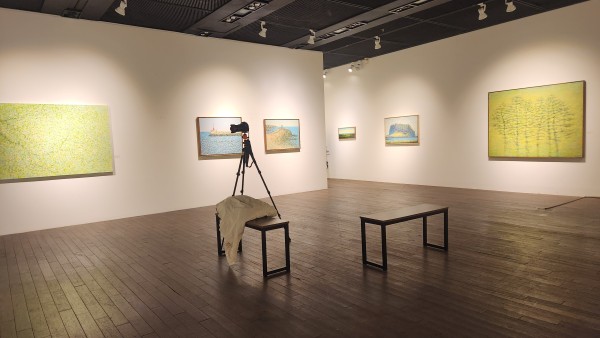
Media shovel visited Shinchon Byeolgok, a solo exhibition by painter Baek Sungwon, on view from January 7 to January 26, 2026, at Insa Art Center (B1F, Gallery 1), Insa-dong, Seoul.
Rooted in the landscapes of Shinchon-ri, Jeju Island, where the artist has lived and worked for many years, the exhibition unfolds as a meditation on nature, healing, and the fundamental nature of painting.
Rather than functioning as a literal depiction of place, Shinchon Byeolgok explores how lived landscapes become internalized and transformed through painterly experience.
For Baek, “Shinchon” is far more than a geographic reference.
“Shinchon is the place where I stayed, worked, and eventually found my way back to painting,” the artist explains.
Following a long hiatus marked by illness and surgery, Baek experienced both physical and emotional recovery within the natural environment of the village.
The quiet coastal settlement—where sea, village, and Hallasan Mountain coexist within a single horizon—became a site of healing and a renewed point of departure.
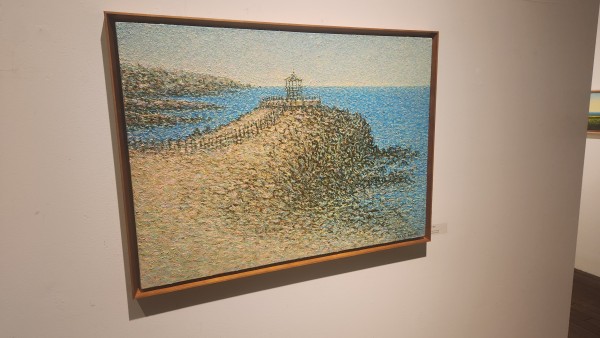
During this period, Baek walked the roads of Shinchon daily, observing the landscape at close range: stone walls along the shore, the clustered houses beyond them, Hallasan’s layered silhouette in the distance, and trees that stood unwavering in their place.
Rather than reproducing these scenes, Baek focused on translating the sensory encounter with nature into painting. The works in Shinchon Byeolgok do not aim for topographical accuracy; instead, they materialize the rhythm, energy, and presence that nature imparts.
A recurring motif throughout the exhibition is the coastal pine (haesong). Shaped by salt-laden winds and harsh conditions, the tree stands as both a symbol of Jeju’s environment and a projection of the artist himself.
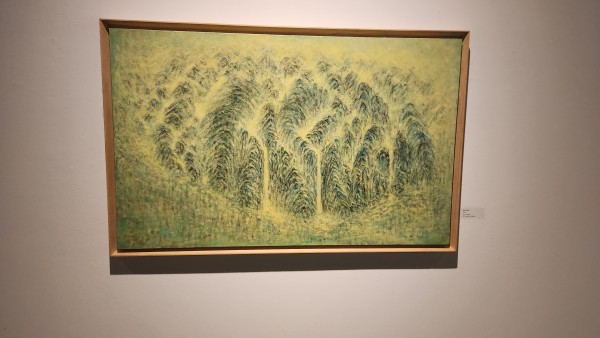
“At times, the pine tree feels like my own stance,” Baek notes. “At other moments, Hallasan feels like a reflection of myself.”
Unmanicured and firmly rooted along roadsides, these pines embody a resilient vitality—an endurance mirrored in the artist’s own trajectory.
A noticeable shift also emerges in Baek’s painterly method.
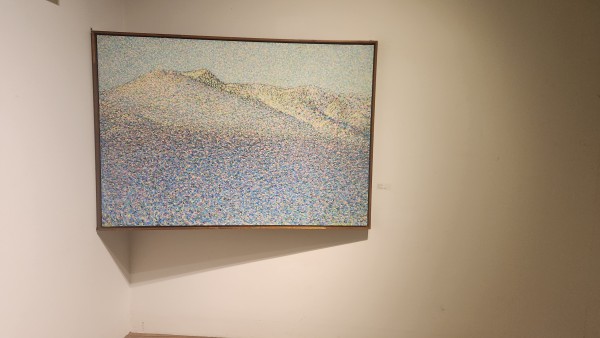
Whereas earlier works relied on pre-mixed colors on a palette, his recent practice constructs the surface from the outset through dispersed fragments of color, applied as dots or marks.
Color remains fluid, constantly evolving through the act of painting itself. Yellows transition into reds, reds dissolve into blues, layering into a pulsating rhythm across the canvas.
Baek describes this process as “a structure woven like a neural network, where rhythm emerges organically through accumulation.”
This approach reflects the artist’s broader understanding of painting. Baek often refers to his work as “visual music.” For him, painting is defined by rhythm and resonance—generated through relationships between color and form, layering and erasure.
This sensibility extends to his titles, which frequently draw from musical forms such as byeolgok or yeonga.
The stratified layers of color rise from the lower register of the canvas, gradually expanding until they resonate across the entire surface, much like a symphonic composition.

Viewers frequently describe a sense of warmth and quiet consolation when encountering Baek’s paintings. The artist attributes this response to a sincerity in his engagement with nature.
He views nature as an idealized realm—one that humanity continually longs for.
If the byeolgok of classical literature represented a departure from worldly burdens toward nature, Shinchon Byeolgok can be read as a contemporary pictorial narrative seeking to restore a sense of lost human essence.
For Baek Sungwon, art is neither a profession nor a mere outcome.
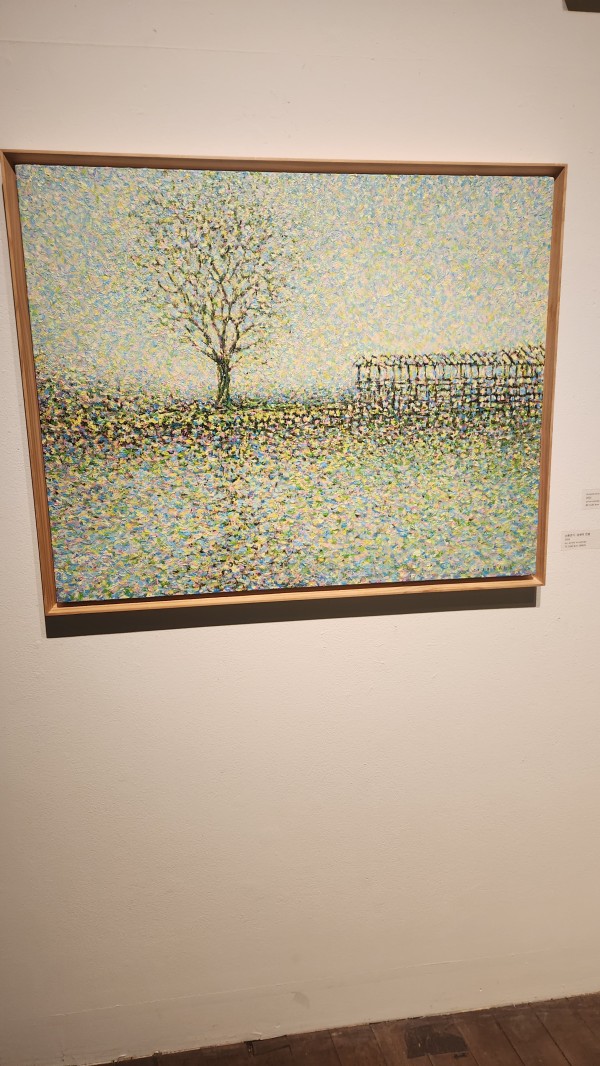
He speaks of his works as entities that carry “the energy of living matter.” Just as music or literature can elevate human consciousness beyond the ordinary, he believes painting possesses the power to return viewers to a state closer to their core nature.
In this sense, art is not something to be owned, but a process of shedding excess desire and velocity.
Addressing an era in which AI and technology rapidly encroach upon artistic domains, Baek maintains a clear position. “There are realms technology cannot reach,” he asserts. The tactile density of paint, the texture of the surface, and the immediacy of brushwork can only be fully experienced in physical encounter.
For this reason, Baek continues to commit himself to painting, preserving a form of artistic agency grounded in the human hand.
Shinchon Byeolgok also marks Baek Sungwon’s first solo exhibition in Seoul.
Having worked primarily in Jeju for many years, he reflects on the significance of regional artists entering central art circuits.
Regarding Insa-dong, he remarks, “Newness alone cannot exist.” As a site where tradition and the present coexist, Insa-dong remains a vital space for artistic exchange—one that sustains continuity while allowing for renewal.
Rather than relying on spectacle or instant messaging, Shinchon Byeolgok invites viewers into its world through slowly accumulated color, rhythm, and temporal depth.
Baek Sungwon’s paintings pose a quiet yet persistent question: How far have we drifted from nature—and can art still narrow that distance?
This exhibition offers the artist’s measured, resonant response.