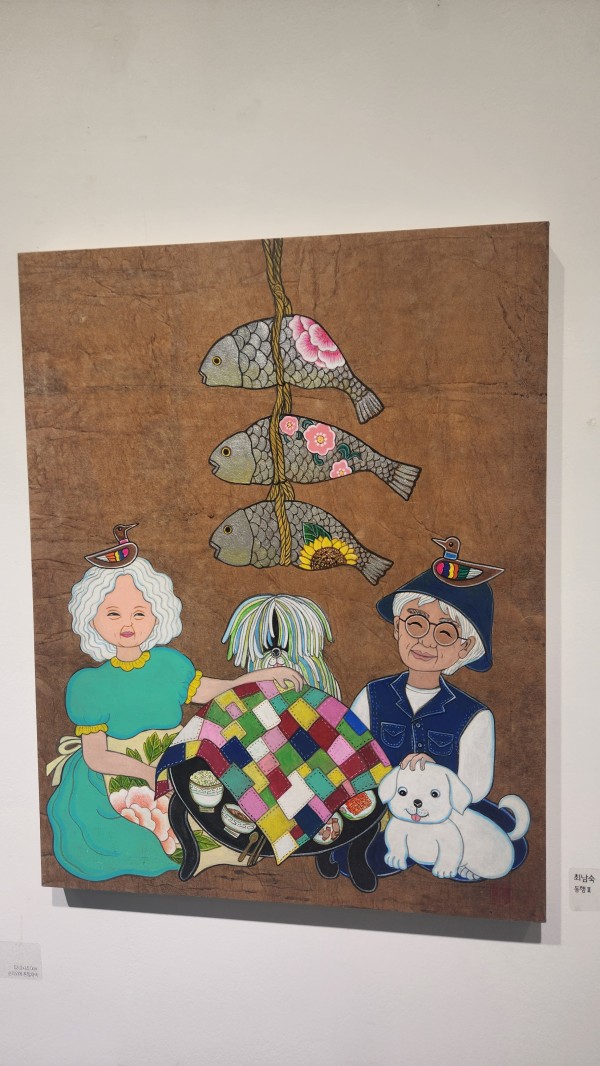
The 5th annual exhibition of the Korea Association of Women Artists with Disabilities opened on December 3 and concluded on the 8th at Maru Art Center’s Gallery 1 (Insadong-gil 35-6)
Shovel Media spoke with Kim Mi-ran, President of the Korea Association of Women Artists with Disabilities, who provided an unfiltered view of the realities facing disabled women in the arts.
Although cultural and arts support systems for people with disabilities have expanded in recent years, the voices from the field tell a more complicated story.

Government funding programs certainly exist, yet there is growing concern that these resources are not reaching the individuals who need them the most.
Many disabled artists struggle even to secure a basic workspace, and Kim notes that “those who are just starting out often have no opportunities at all.” While some artists with established studios and careers apply for—and receive—multiple rounds of support, newcomers and those in precarious circumstances frequently encounter barriers from the very first application stage.
Kim, who has long observed the structural gaps in the disability arts sector, says she was motivated to focus on supporting women with disabilities because they often face dual layers of vulnerability.
Disabilities can occur unexpectedly, and for many women, they come with simultaneous economic and social isolation.
She has seen numerous cases in which a woman becomes disabled during marriage, is subsequently abandoned by her spouse, and is left to raise children alone. “In that shock, many seek out welfare centers for healing,” she says, emphasizing that those in the most fragile situations are the ones who turn to art as a vital form of expression.
Although she herself is only able to use her right hand, Kim never stopped painting. Drawing from her background in watercolor and her administrative experience, she began helping other disabled women artists—only to find yet another systemic challenge: verifying artistic authorship.
In the case of artists with developmental disabilities, questions sometimes arise about how much of a work was completed by the artist themselves.
When physical limitations prevent them from finishing parts of a painting, support workers may assist by coloring or outlining.
Kim stresses the importance of transparency—clearly stating which parts were done by the artist and which required assistance—to preserve fairness.
A lack of clarity, she warns, can erode trust not only in disability arts but in the broader art market, which already grapples with ongoing issues around authorship, copyright, and production ethics.
The vulnerability is compounded by the fact that disabled artists often have limited access to institutional knowledge, legal resources, and information, making them more susceptible to exploitation.
Another fracture line Kim identifies is the growing divide within the disability arts ecosystem.

Non-majors who participate in community-based programs often gain early access to benefits and networks, while trained artists with degrees in fine arts find themselves with fewer opportunities.
While formal education is not the sole measure of artistic skill, Kim notes that without any system of evaluation, standards across the market can blur, leading to closed circles and exclusions.
Despite these challenges, Kim continues her work because she believes firmly that the essence of art lies in the work itself—not competition. “If a piece is good, it deserves recognition. If it’s lacking, the artist can keep improving. There’s no need to tear each other down,” she says.
Still, the deeply rooted competitive structures of Korean society inevitably surface within the disability arts field as well, drawing lines between majors and non-majors, those with experience and those without, and those affiliated with institutions versus independent artists. These distinctions can sometimes stifle genuine artistic potential.
Kim has devoted 15 years to this field. She initially funded exhibitions out of her own pocket, and later continued the association’s founding exhibitions through donated spaces.
This year, the fifth installment was held with government support for the first time. The association also invited professors to provide lectures on materials, techniques, and artistic practices—an invaluable resource for many disabled women artists who do not have formal training.
For Kim, disability arts is far more than simply offering an outlet for creative activity. It serves as a pathway for individuals to rebuild their lives and reconnect with society.

Yet the path forward remains lined with unresolved issues: the effectiveness of support systems, transparency in artistic production, trust in the art market, disparities between trained and untrained artists, and the principle that the most vulnerable should receive opportunities first.
These questions no longer belong solely to bureaucracy—they reflect how Korean society chooses to define the value and dignity of disability arts.