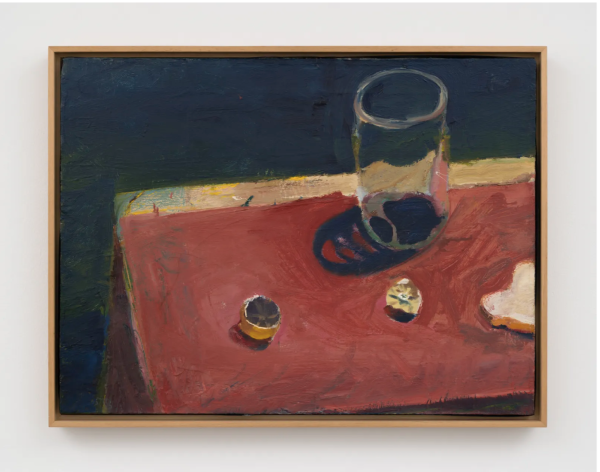
Richard Diebenkorn Untitled (Lemons and Jar) (CR no. 2521), 1958 Oil on canvas 18 x 24 in 45.7 x 61 cm © 2026 Richard Diebenkorn Foundation / Artists Rights Society (ARS), New York
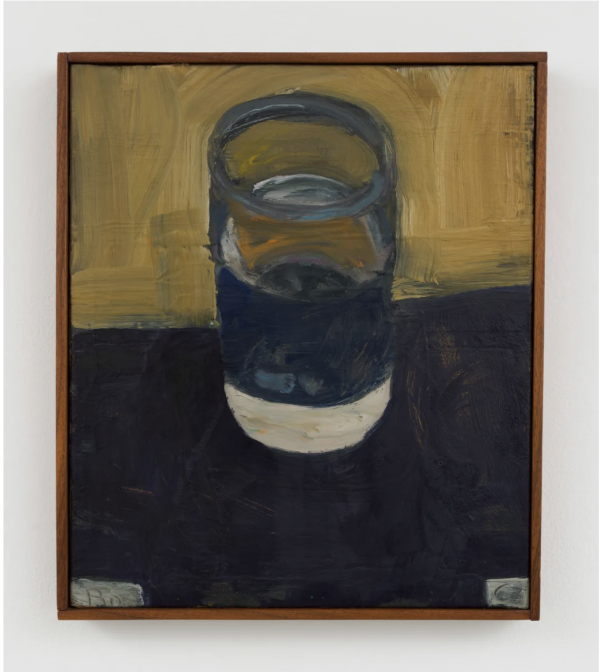
Richard Diebenkorn Jar (CR no. 3364), 1963 Oil on canvas 15 x 12 3/4 in 38.1 x 32.4 cm © 2026 Richard Diebenkorn Foundation / Artists Rights Society (ARS), New York
Van Doren Waxter is pleased to present Still Life, an extraordinary exhibition of paintings and works on paper by the revered American master Richard Diebenkorn, running from April 29 to June 26, 2026.
This landmark presentation showcases fourteen exceptional works sourced directly from the Diebenkorn family collection that have never previously been offered for sale, casting a focused spotlight on the artist’s seminal Berkeley period still lifes produced between 1956 and 1967.
Diebenkorn’s representational output during these critical California years beautifully demonstrates what curator and scholar Steven Nash identified as the artist's genuine, unwavering allegiance to nature.
Even as he aggressively pursued abstraction, the formal paintings of European masters like Pierre Bonnard, Paul Cézanne, and Henri Matisse remained a foundational source of structural inspiration.
Within his own canvases, everyday objects salvaged from his home and studio—a knife cutting decisively into a ripe tomato, a lit match warming the fingertips of a hand, or a pair of scissors balancing precariously on the rim of a coffee cup—collide at precise structural angles, creating a suspended pause that pushes back against the raw, atmospheric friction of the surrounding paint.
Through Diebenkorn's singular vision, these mundane, domestic objects are elevated to the extraordinary, repurposed as deliberate instruments of pictorial tension. A solitary, empty chair becomes abundant with evocative capability and compact symbolism, functioning as a multifaceted painterly tool that reflects natural daylight, throws sharp shadows, anchors the horizon with physical gravity, and fractures the neat balance of a rectangular picture plane. The sparse environments enveloping these household items often lack detailed description, expanding into infinite, boundless spaces despite their intimate material scale, which effectively yields the physical stage to the texture of the paint itself. Much like his celebrated purely abstract compositions, the thick information embedded within the brushstrokes communicates deep emotion, allowing this specific collection of still lifes to capture an incomplete, trembling stillness—a visual mapping of the slow, quiet pacing of universal molecules.
Born in Portland, Oregon in 1922, Diebenkorn accumulated a sophisticated academic pedigree, studying at Stanford University, the University of California, Berkeley, the California School of Fine Arts, and the University of New Mexico, Albuquerque.
While his earliest essays in abstraction were forged during the late 1940s and early 1950s while living in Sausalito, Albuquerque, and Urbana, Illinois, his relocation to Berkeley in 1953 sparked a legendary burst of productivity yielding over sixty-six abstract canvases in just two years.
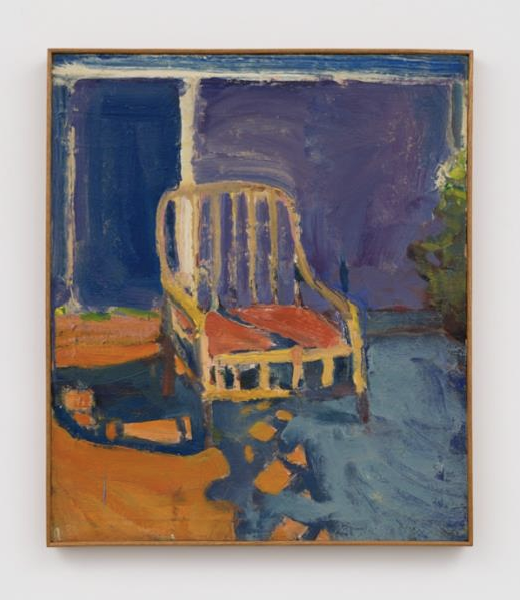
Chair Outside (CR no. 2717), c. 1959, Oil on canvas, 28 x 24 in (71.1 x 61 cm) (RD 1252)
The year 1955 marked a radical professional pivot toward an eleven-year period dedicated to direct observation, during which he produced figurative works from live models alongside landscapes, interiors, and these critical still lifes.
He later relocated to Santa Monica, teaching at the University of California, Los Angeles, and commencing his epic, career-defining Ocean Park cycle in 1967. His final years were spent in Healdsburg, California, where he worked exclusively on intimate works on paper until his passing in 1993.
Diebenkorn’s distinguished career has been commemorated through numerous monographic museum surveys globally, including major traveling exhibitions organized by the Museum of Modern Art, the Whitney Museum of American Art, the Fine Arts Museums of San Francisco, and the Royal Academy of Arts in London.
His profound legacy was further cemented by monumental academic achievements, including representing the United States at the 38th Venice Biennale in 1978, receiving the National Medal of Arts in 1993, and the posthumous publication of his definitive multi-volume Catalogue Raisonné by Yale University Press.
This definitive scholarship expanded with the publication of the definitive Richard Diebenkorn: The Catalogue Raisonné of Prints, which offered the first comprehensive examination of the artist’s prolific printmaking output.
By bringing these intensely personal, never-before-seen Berkeley still lifes to the public, Still Life provides an invaluable portal into the intimate machinery of an American icon’s evolution.
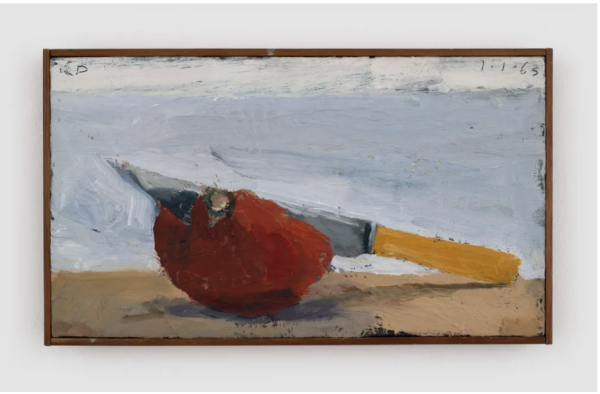
Richard Diebenkorn Knife + Tomato II (CR no. 3362) , 1963 Oil on wood panel 9 x 15 3/4 in 22.9 x 40 cm © 2026 Richard Diebenkorn Foundation / Artists Rights Society (ARS), New York