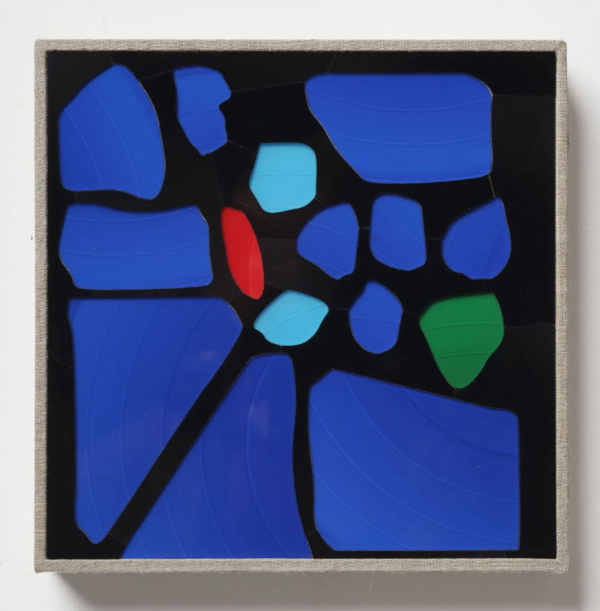
Gregor HildebrandtBlau im Gedächtnis (A194), 2025Cut records, canvas, aluminium, wood
24 x 24 cm
9 1/2 x 9 1/2 inches
Perrotin
Perrotin is pleased to present Blau im Gedächtnis (Blue in Memoriam), Gregor Hildebrandt’s latest exhibition, inspired by the iconic interior windows of Berlin’s Kaiser Wilhelm Memorial Church—one of the most emblematic landmarks of postwar West Berlin.
The exhibition translates the church’s stained-glass motifs into an immersive installation composed of small-scale vinyl record paintings that extend across the entire gallery space.
The result is an environment that envelops the viewer, merging architectural memory with material transformation.
The project originated with a gift: a vinyl recording of Johann Sebastian Bach’s cantata Ich habe genug (“I have enough”), offered by a friend aware of Hildebrandt’s long-standing engagement with vinyl as both medium and metaphor.
The cantata’s title—resonating with resignation, relief, and understated irony—sparked a moment of shared recognition, rendering a work from 1727 unexpectedly attuned to contemporary sentiment.
The record sleeve featured an image of the blue glass tiles of the Kaiser Wilhelm Memorial Church, where the cantata was recorded.
Bathed entirely in blue light, the church interior offers visitors an immersive, sensorial experience. Its fragmented windows evoke a celestial expanse—suggestive of stars, clouds, and vast nocturnal space—creating an atmosphere that is as physical as it is emotional.
Originally constructed in 1891 and largely destroyed during the Second World War, the church was preserved as a ruin and later integrated into a modern ensemble designed by architect Egon Eiermann in the 1960s.
Known colloquially as the “Hollow Tooth,” the surviving tower stands as a visible marker of Berlin’s history, bridging destruction and renewal. Surrounding the ruin are newly built structures clad entirely in blue glass tiles created by French artist Gabriel Loire, whose stained-glass works appear in sacred architecture worldwide.
For Hildebrandt, encountering Bach’s cantata alongside the image of these blue tiles became the catalyst for Blue in Memoriam: a meditation on space, light, and memory, as well as on sound and its absence.
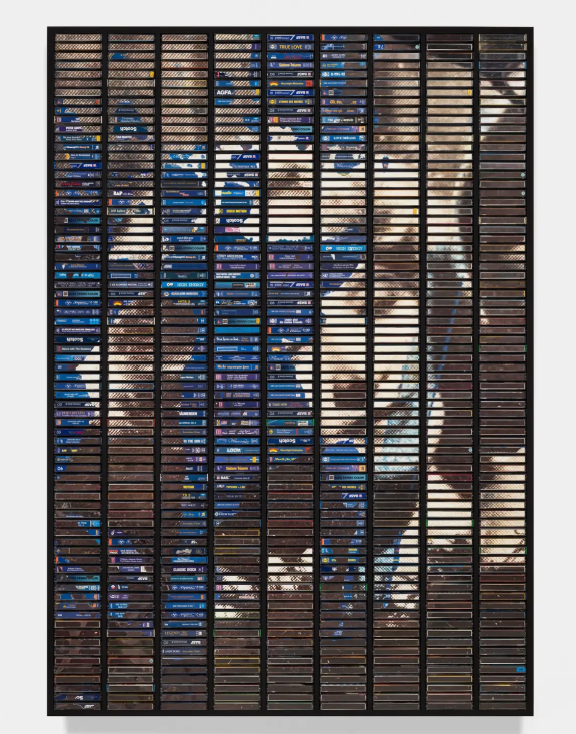
Gregor Hildebrandt Friedemanns Marlene, 2025 Ink jet print, plastic cases, inlays in wooden case 158.2 x 112 x 8.5 cm 62 3/8 x 44 1/8 x 3 3/8 inches Perrotin
The installation consists of nearly 3,000 tiles produced from over 8,000 vinyl records pressed specifically for the project.
Each tile measures 24.1 × 24.1 cm, mirroring the dimensions of the church’s original windows, and is precisely cut using water-jet technology. At close range, the grooves of the vinyl remain visible—an essential detail in Hildebrandt’s practice.
These grooves function like painterly brushstrokes, structuring each tile while alluding to their former role as vessels of sound.
While the tiles visually echo the chromatic luminosity of stained glass, their material identity introduces a subtle tension between illusion and substance, memory and reconstruction. Hildebrandt’s fascination with vinyl and windows extends well beyond this installation.
His early works revisited the colored-glass window of his grandmother’s home in southwest Germany, initiating an ongoing inquiry into how spaces can be remembered, rebuilt, or reimagined through sound-bearing materials.
The records used in Blue in Memoriam originate from Anne, a German band whose releases Hildebrandt produces through his label, Grzegorzki Records.
In this project, the B-side of Anne’s album Flamingo—melancholic and rhythm-driven—resonates silently within the architecture of the work. Although music is central to Hildebrandt’s practice, his artworks remain mute.
Through acts of pressing, fragmenting, and reassembling vinyl, latent sound is given new spatial form.
This translation of sound into structure is a defining element of his oeuvre, evident in works that transform audio tapes, magnetic strips, and recordings into physical obstacles or architectural interventions. With Blue in Memoriam, this transformation reaches a heightened level of spatial ambition.
By enveloping the gallery entirely in vinyl tiles, the installation evokes the contemplative atmosphere of sacred architecture while grounding the experience in the materiality of the present.
The blue light that fills the space recalls the transcendence of the church interior, yet the tactile presence of vinyl asserts a contemporary sensibility.
The work invites viewers not merely to observe, but to linger—to experience how space, memory, and perception shift within its luminous embrace. In doing so, Hildebrandt transforms music into architecture, weaving together private memory and collective history into an experience that transcends time and place. — Laura Helena Wurth
Drawing from music, cinema, and underground culture, Berlin-based artist Gregor Hildebrandt produces paintings, collages, sculptures, and immersive installations that activate both personal and collective memory.
Central to his practice is the use of analogue recording media—including vinyl records, VHS tapes, compact discs, and audio cassettes—which serve as both material and conceptual frameworks for his work.
Early Life and Artistic Formation Born in Bad Homburg, Germany, Hildebrandt studied Fine Arts at Johannes Gutenberg University in Mainz, graduating in 1999.
He continued his studies at the University of the Arts in Berlin later that same year. It was during the late 1990s that he began to develop an artistic language focused on translating music into visual form.
One of his early experiments involved embedding a cassette tape of a selected song directly into a sketchbook—an attempt to give physical presence to something inherently intangible.
As Hildebrandt has noted, the immaterial nature of music has long preoccupied him, prompting his desire to render sound visible and tactile. “Rip-off” Paintings A foundational element of Hildebrandt’s practice is his series of cassette tape and VHS tape paintings, which integrate references to music and film into a restrained visual vocabulary.
These works underpin a broader methodology that merges aspects of found-object art with minimalist aesthetics.
The process involves the creation of paired canvases.
One primed surface is covered with vertical strips of adhesive tape and painted with a translucent fixative.
Audio or video tape is then applied in vertical bands, allowing the magnetic coating to adhere to the exposed adhesive areas and detach from its plastic backing.
The removed magnetic material is transferred onto a second primed canvas, resulting in two related works—positive and negative iterations of the same composition.
The resulting “rip-off” paintings are abstract, frequently monochromatic, and formally concise, ranging from expressive surfaces such as Staring at the Sea (Cure) (2018) to more rigorously structured works like Ich hab mich auf den Boden gelegt (Toco) (2018).
In many exhibitions, these paintings are accompanied by large-scale installations in which unspooled magnetic tape is transformed into architectural wall curtains that redefine the exhibition space.
Vinyl Records Since the early 2000s, vinyl records have been another central medium in Hildebrandt’s practice.
In 2004, he encountered the practice of repurposing old records into bowls and reimagined them as “sound vessels.” Adapting this method, he began creating towering, column-like forms reminiscent of Brancusi, as well as expansive walls composed of stacked vinyl bowls.
In In meiner Wohnung gibt es viele Zimmer (In My Apartment, There Are Many Rooms) (2018) at Perrotin New York, the gallery space was divided by walls constructed from thousands of stacked vinyl forms. These included black records sourced from flea markets alongside custom-pressed records in white and various colors.
Beyond sculptural installations, Hildebrandt also produces large-scale abstract compositions using square and triangular sections cut from vinyl records.
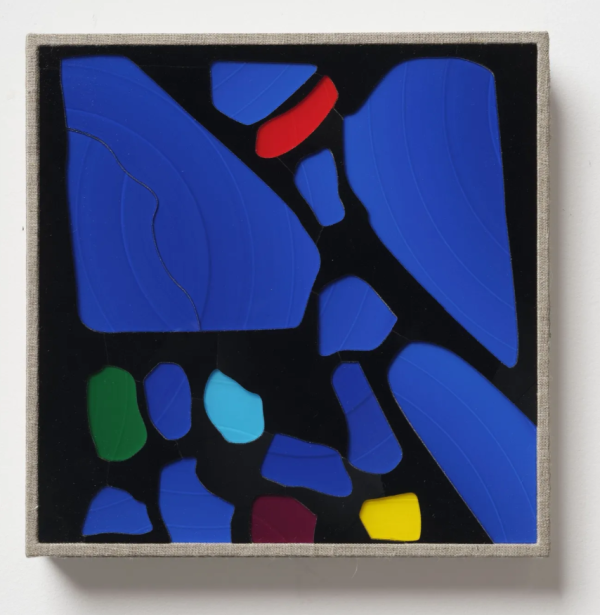
Gregor Hildebrandt Blau im Gedächtnis (A197), 2025 Cut records, canvas, aluminium, wood 24 x 24 cm 9 1/2 x 9 1/2 inches Perrotin
Initiated around 2015, this body of work has increasingly incorporated custom-colored vinyl, resulting in geometric, chromatic patterns that recall modernist traditions associated with artists such as Piet Mondrian and Anni Albers.
In 2018, Hildebrandt founded his own record label, Grzegorzki Records, and has since integrated newly released vinyl from the label directly into his artistic practice. Romantic Narratives Although the recordings embedded in Hildebrandt’s works are rendered silent through the process of transformation, their original content remains conceptually significant.
The artist deliberately selects music that has accompanied him for decades, including songs by Einstürzende Neubauten, The Cure, Jacques Brel, Tocotronic, and Björk.
Lyrics from these works frequently appear in his titles, alongside references to poetry and cinema. Collectively, these titles form a poetic framework marked by romantic sensibility, melancholy, and quiet solitude.
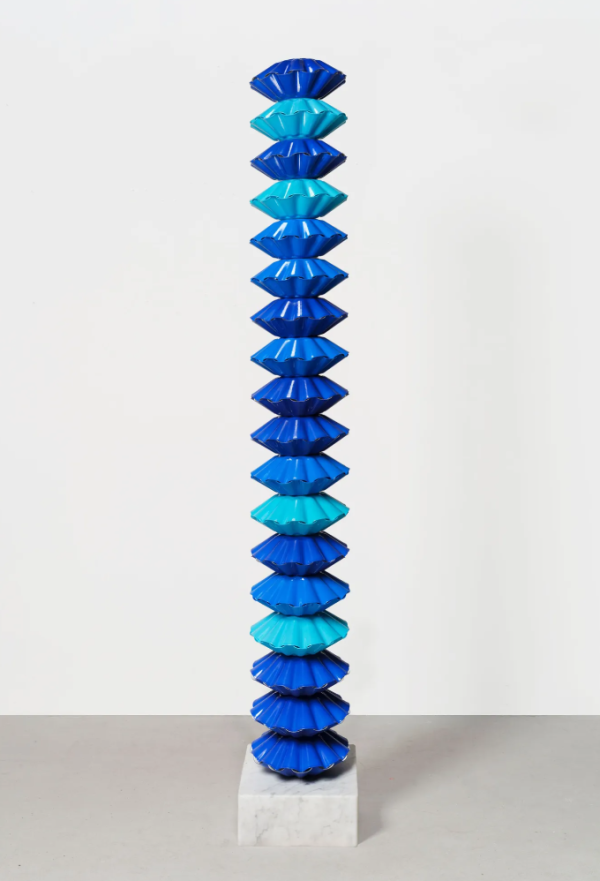
Gregor Hildebrandt Blaue Säule, 2025 Compression-molded records, metal bar, marble plinth 199.5 x 31 x 31 cm 78 5/8 x 12 1/4 x 12 1/4 inches Perrotin