
cogniBIT participated in the comeup2025 startup event held at COEX , south korea from the 10th to the 12th and had an interview with the media shovel ( shovell.io.)
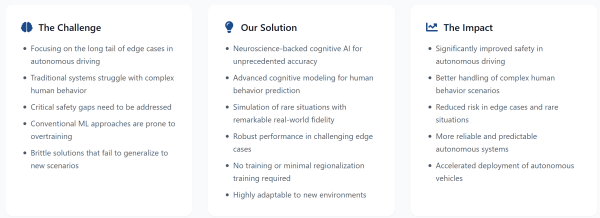
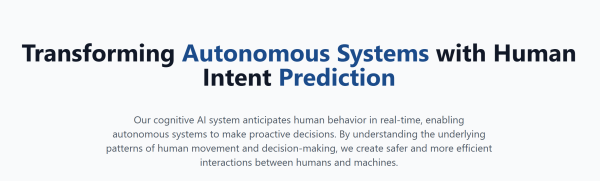
The company is developing a cognitive AI system designed to understand, interpret, and predict human behavior in complex, dynamic environments, with a particular focus on autonomous mobility. Rather than concentrating solely on vehicle control, the technology addresses the unpredictability of human behavior in traffic, where intention, emotion, and risk perception play a decisive role.
As the company looks to expand into Asia, South Korea has emerged as a strategically important market due to its dense urban environments and advanced mobility infrastructure.
Unlike many existing autonomous driving systems that rely almost entirely on end-to-end machine learning trained on large volumes of recorded data, this cognitive AI approach combines machine learning with neuroscience-based modeling and rule-based engineering.
This hybrid architecture enables the system to anticipate human intentions one to three seconds in advance, shifting autonomous driving from a reactive model to a predictive one. Inspired by how humans naturally anticipate danger rather than merely respond to it, the system is rooted in years of academic research in neuroscience conducted by the founding team.
Safety and trust are addressed through transparency. While many data-driven autonomous systems operate as black boxes, offering little insight into why specific decisions are made, this system is designed as a white-box model.
Every action—whether accelerating, braking, or steering—can be explained and traced, an approach that is particularly important for safety certification, regulatory approval, and public trust. This transparency also helps prevent hallucinations, a known risk in purely data-driven systems when they encounter unfamiliar or ambiguous scenarios.
Recognizing that traffic behavior varies significantly across regions, the system incorporates models that account for cultural and statistical differences in driving behavior, such as levels of aggressiveness, caution, or rule compliance.
By adapting to local traffic cultures, the technology is suited for deployment across diverse environments, from Europe and the United States to highly congested cities in Asia, including South Korea.
From a commercial standpoint, the company is initially focusing on commercial mobility applications such as trucking, logistics, robotaxis, and public transportation.
These sectors face mounting challenges, including driver shortages, rising labor costs, and aging populations, making autonomous systems both economically and socially compelling. Over time, the technology is expected to extend into private mobility as well, particularly benefiting elderly users and those seeking safer and more convenient transportation alternatives.
The company is already collaborating with industry partners, including a truck manufacturer in Europe and a robotaxi company in the United States, while actively seeking partnerships in South Korea to transition from simulation-based testing to real-world deployment within full autonomous driving stacks.
Artificial intelligence is also reshaping internal workflows and job structures. By integrating AI tools into development processes, smaller teams are now able to achieve outcomes that previously required much larger engineering groups. While AI transforms how work is done, human creativity, innovation, and complex judgment remain essential, as AI systems are ultimately limited by the scope of their training.
Regulation is viewed not as a barrier but as a necessary framework for safe deployment. Although regulatory processes, particularly in Europe, can slow implementation, they also establish rigorous standards. The company’s emphasis on explainability and transparency aligns closely with these regulatory requirements, positioning it favorably for long-term adoption.
Looking ahead, autonomous mobility is expected to become increasingly integrated into everyday life within the next five to ten years, particularly in logistics, public transportation, and shared mobility services. Changing social attitudes toward car ownership, combined with the needs of aging populations and the demand for safer, more efficient transportation, are likely to accelerate adoption.
At a personal level, the work is driven by a desire to improve quality of life. Autonomous systems have the potential to reduce stress, save time, enhance safety, and lower energy consumption, representing not just a business opportunity but a meaningful technological shift toward more human-centered mobility.
Founded at the University of Munich in Germany, cogniBIT is a deep-tech artificial intelligence company specializing in cognition-based AI technologies. At the core of its innovation is an intelligent traffic behavior model designed to understand and predict human actions in complex mobility environments, enabling more accurate and reliable decision-making for intelligent systems.
Currently, cogniBIT’s technology is primarily applied within advanced simulation environments, where it supports the development and validation of next-generation mobility solutions.
Building on this foundation, the company plans to expand its technology into real-world applications, including autonomous vehicles and robotic systems, marking the next phase of its growth and technological evolution.
cogniBIT actively collaborates with a wide range of industry partners, including autonomous driving software developers, automotive manufacturers, semiconductor companies, and producers of autonomous mobile robots. Through these partnerships, the company aims to bridge academic research and industrial deployment, accelerating the adoption of safe and intelligent autonomy.
Headquartered in Munich, Germany, cogniBIT also operates a business hub in Hong Kong, strengthening its global presence and supporting strategic expansion across European and Asian markets.