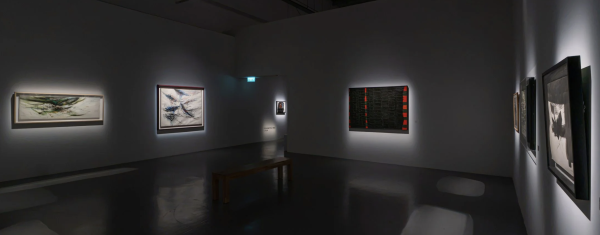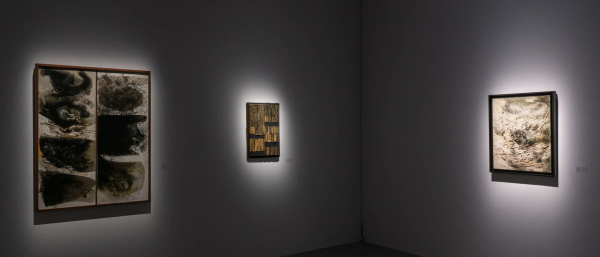
Unveiling a pivotal historical chapter in the Japanese Art Informel movement, this inaugural exhibition honors the foundational legacy of Whitestone Gallery’s 1967 establishment and reinforces its guiding motto, “Art as a Voice for Peace.” The presentation centers on the raw, visceral intensity and gestural force of Hisao Domoto and Toshimitsu Imai, two primary masters who served as Japan’s foremost interpreters of the European movement Art Informel ("Art Without Form").
By confronting traditional artistic paradigms, both painters constructed a groundbreaking visual lexicon of abstraction.
Coined by French critic Michel Tapié in 1950, Art Informel emerged from the profound disillusionment of post-World War II Europe, rejecting the era's rigid, geometric abstraction in favor of pure intuition, spontaneous improvisation, and uninhibited painterly freedom.
Relocating to Paris in the 1950s, Domoto and Imai embedded themselves within the intellectual epicenter of this avant-garde movement.
By placing Eastern philosophy and aesthetics into active dialogue with European abstraction, they spearheaded a transformative cross-cultural synthesis that permanently expanded the boundaries of global modernism.
Far beyond a stylistic trend, Art Informel functioned as a medium for intercultural exchange grounded in human perception, emotion, and raw material expression.
Arising from the devastation of war, it articulated a universal language of suffering, resilience, and rebirth.
Domoto and Imai’s canvases stand as enduring witnesses to the human cost of conflict, invoking empathy, shared humanity, and peace—a historical reflection that directly challenges contemporary viewers to reconsider the realities of modern warfare and violence.
Born in Kyoto to an artistic family, Hisao Domoto (1928–2013) received formal training in traditional Japanese painting before moving to Paris in 1955. Immersing himself in the peak of Art Informel, he embraced European postwar freedom while retaining an innate sense of order rooted in his Japanese heritage.
Domoto's signature aesthetic features dense impasto, dynamic palette choices, and sweeping, expressive brushwork executed through powerful physical movement.
Through his continuous exploration of gesture, materiality, and organic rhythm, Domoto re-envisioned abstract painting as a harmonious bridge between Eastern thought and Western modernism.
Toshimitsu Imai (1928–2002) stood among the earliest Japanese artists to integrate into the Parisian avant-garde following his arrival in France in 1952.
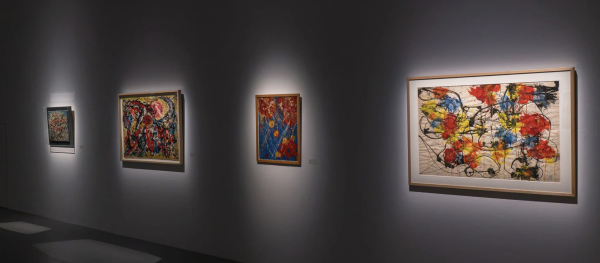
Defined by energetic brushstrokes, tactile textures, and vibrant chromatic intensity, Imai’s compositions embody the essential spontaneity and physical presence of Art Informel, reimagined through a distinct Japanese sensibility.
Beyond his studio practice, Imai served as a crucial cultural ambassador by introducing Art Informel to Japan in 1956.
Through curated exhibitions and international collaborations, he bridged the artistic communities of Paris and Tokyo, shaping a new generation of postwar Japanese abstraction and highlighting the fluid, transnational movement of modern art.