Anthony McCall
From February 5th to June 14th, 2026, the Ulsan Museum of Art’s XR Lab presents the exhibition Line Describing a Cone 2.0.
This showcase spotlights the visionary world of Anthony McCall, specifically his "Solid Light" series, which dissolves the boundaries between cinema, sculpture, and installation.
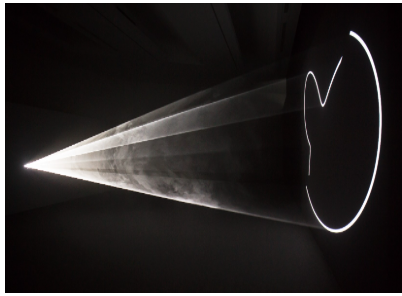
In his work, a moving line of light slowly traverses the room to forge a conical volume, transforming the viewing experience from a static observation into a temporal event.
McCall’s journey began in the early 1970s amidst the "Expanded Cinema" movement. In 1973, he debuted the original Line Describing a Cone, utilizing a 16mm projector and ambient cigarette smoke to give form to light.
While the projection created a massive conical shape in space, technical limitations and the rigid artistic conventions of the era led McCall to pause his practice for nearly twenty years.
He reached a pivotal turning point in the early 2000s by transitioning from analog film to digital files, a shift that influenced both the format and the philosophical depth of his work.

This technological transition removed the mechanical white noise of the film projector, allowing visitors to focus more intensely on their own bodies and internal sensations.
Furthermore, simple line animations evolved into rhythmic, lyrical drawings, while haze machines replaced unpredictable cigarette smoke to reveal the architectural structure of light with newfound precision.
The most striking evolution in McCall’s post-2000s work is the active physical involvement of the audience.
Visitors are no longer passive observers standing before a screen but are instead invited to step inside the cone of light.
As they move through the installation, their bodies appear to be segmented or divided by the beams, making basic movements and the act of navigation an integral part of the artwork itself.

In this context, light is no longer an object to be looked at, but rather a physical experience to be perceived through the senses.
Line Describing a Cone 2.0 does not offer a finished product but instead presents the process of light being drawn in real-time.
The exhibition invites viewers to position themselves within the unfolding forms, experiencing shapes that emerge and vanish within the dimension of time.
Ultimately, the artwork does not exist on a screen, but is formed within the viewer’s body, their senses, and the specific atmosphere of the moment.