100cm x 150cm The Month Of … The earth and sky are filled with fragrance: a gentle, sweet-smelling breeze blows softly. Beauty is everywhere and perfume pervades the air, inebriating the bee and filling with longing the heart of the lover far from home. I beseech you, who have made me so happy…not to leave me in the month of love
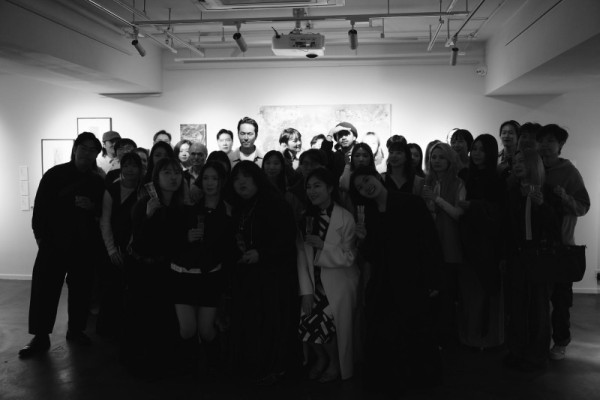
From February 8th to March 31st, 2026, ba d’arts presents a compelling group exhibition titled "The 13th Tense – Present Past Tense," curated by Hui Ka Ling and Kavieng Cheng.
As Valentine’s Day fills the city with polished romantic declarations, this show offers a quiet counterpoint by turning its gaze toward the lingering echoes that remain after love fades.
The exhibition brings together thirteen emerging artists from Hong Kong, London, Paris, Shanghai, and Chengdu to explore the "emotional afterlife" of heartbreak through a diverse range of media, including ceramics, embroidery, kinetic installations, painting, photography, and text.
The curators propose a hypothetical grammatical state, the "Present Past Tense," to describe that familiar but inarticulate moment when a relationship belongs to the past yet stubbornly refuses to leave the present, shaping the way one moves, thinks, and feels in the everyday.

Chan is a contemporary abstract painter whose practice investigates the profound intersections of memory, reverie, and art historical dialogue.
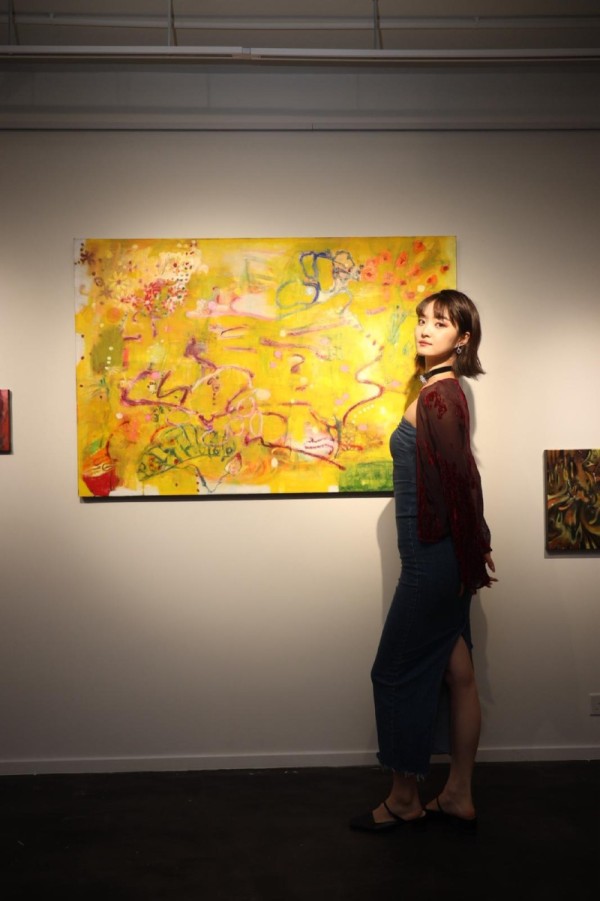
Drawing from a universal visual heritage—spanning prehistoric cave markings to classical mural traditions—she transmutes ancient visual languages into a personal lexicon of forms and symbolic expressions.
Her artistic process generates abstract compositions that oscillate between tangible reality and an ethereal dreamspace, inviting viewers to engage with transcultural memory and metaphysical inquiry.
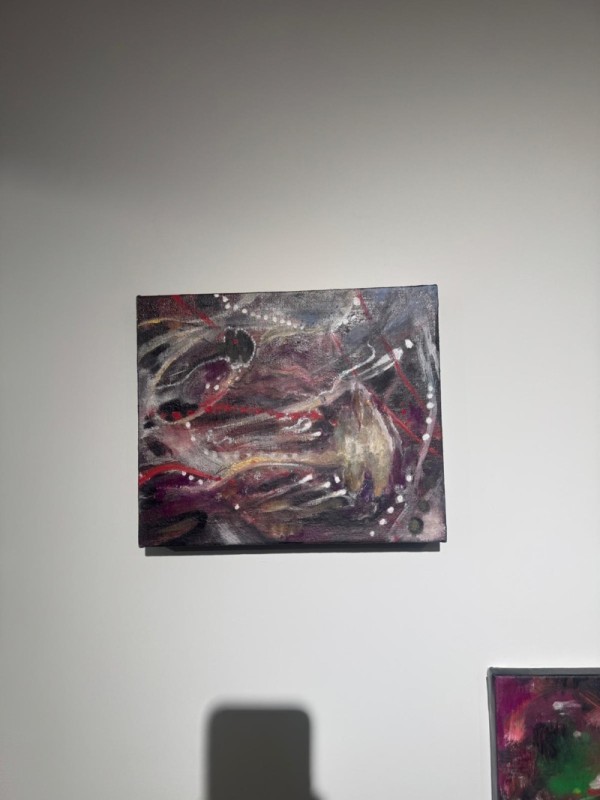
30x24cm Distance makes no difference How can someone separate you from me: your soul from mine? The kite may float and fly where it will, but, at all times, it is attached to someone’s hand.
This series began unexpectedly while she was exploring the British Museum’s digital archives and stumbled upon an ancient Indian love poetry collection.
Though she could not understand the literal words, the raw emotions jumped off the page, leading her to realize that the essence of love and its subsequent loss remains a universal human constant regardless of time or geography.
 24x30cm Biting my mouth in love play
Her face is like the moon. To drink her lips is like sipping Essence of Eternity But grabbing her hair in a frenzy to kiss her with fire and delight: What’s that like?
Through these paintings, Chan attempts to capture the disorienting, in-between state that follows the end of a significant relationship.
She describes this sensation as a form of "constant emotional jet lag," where the physical body exists in the present while the mind remains trapped replaying moments that are already gone.

To visualize this, she employs messy, layered sections that mimic shifting and fading memories, interspersed with sharper, clearer elements that try to pull the consciousness back to the current moment.
She defines this temporal ambiguity as the "13th tense"—a specialized "emotion-time" that is neither past nor present, but a space where endings are acknowledged but not yet fully absorbed.
Her work serves as a visual vessel for anyone stuck between the necessity of moving on and the instinctive impulse of looking back at what was lost.
In the "Rebirth" section of the exhibition, Chan’s work shifts toward the fresh, vibrant energy of a "second act" in love.
These pieces represent the moment when one begins to see the world through new eyes, celebrating the colorful and sometimes messy present rather than dwelling on the past.
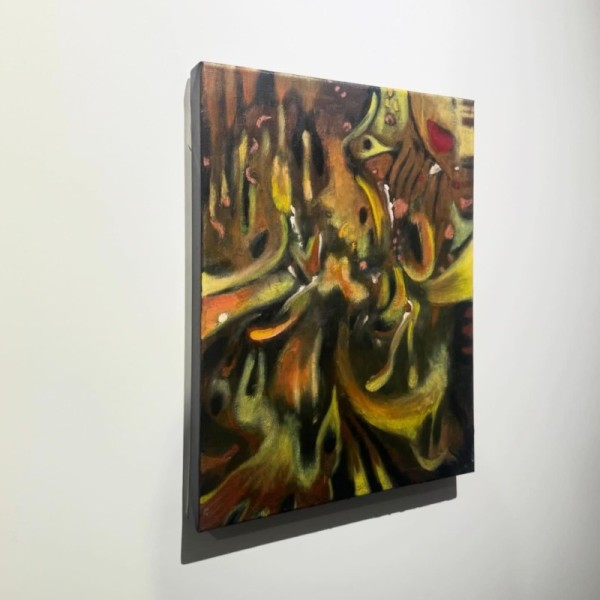
Tomorrow, Tomorrow, Tomorrow 40x30cm He left me saying he would return tomorrow. When will your tomorrow come? Tomorrow, tomorrow, I lost all hopes, My beloved never returned
She hides subtle abstract hints of animals, flowers, and fruits throughout the compositions, treating them like private "inside jokes" shared between herself and the universe.
These playful brushstrokes and dancing shapes are her way of signaling that life is blooming once again.

Her piece "The Love Sync" functions as a visual poem of hearts beating in rhythm, capturing the beautiful cadence found in human togetherness.
Ultimately, the exhibition suggests that tenderness can be found in recognizing what did not last, providing a quiet room where private emotional states find form and shared recognition.