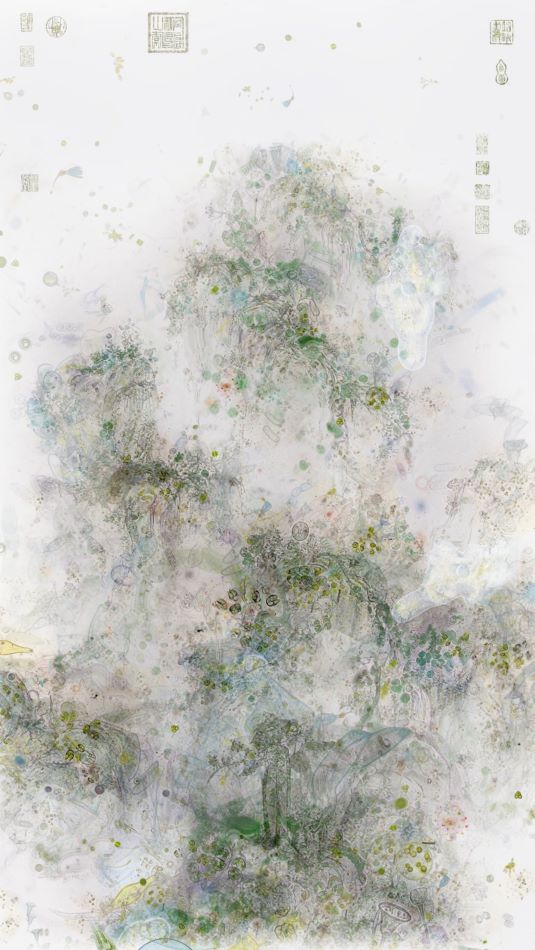
Lee Lee-nam Microscopic Shanshui (Micro-Landscape) - Early Spring No. 1 2026 | Single-channel video, LED Display 75”, 9 min 23 sec | 170.5 × 97.9 cm
Hakgojae Gallery presents Seeing the Formless, Hearing the Soundless: Pictorial Reflection on Life and Existence, a solo exhibition by Lee Lee-nam (b. 1969), running from September 23 to October 24, 2026.
Marking his return to Hakgojae for the first time since 2009, this exhibition moves beyond his well-known Image Transformation series to focus on the movement and vitality that exist prior to the formation of an image itself.
Grounded in his ongoing technical experimentation that expands human sensory perception, Lee takes microscopic biological movements—imperceptible to the naked eye—as his starting point, guiding viewers toward what lies beyond the visible realm through a diverse array of media.
The title Seeing the Formless, Hearing the Soundless stems from an ancient adage about perceiving what is invisible and listening to what is silent, a concept that mirrors Psalm 19, which speaks of a voice that resounds across the earth without physical speech or sound.
The exhibition operates on the premise that being imperceptible to human senses does not equate to nonexistence. Even beyond the threshold of human awareness, countless living entities and material substances undergo an endless cycle of creation and decay.
To capture this hidden world, Lee collected water directly from Yongso Waterfalls and examined it under a microscope, stepping into a microscopic domain inaccessible to the naked eye.
The waterway extending from Yongso Waterfalls to the Yeongsan River serves both as the wellspring of life and a personal site for tracing the artist’s own heritage. By following the traces of microscopic organisms born, moving, and perishing within a single drop of water, Lee poses fundamental questions regarding the origin of life and the trajectory of existence.
The enlarged forms, movements, and clusters of these organisms draw lines reminiscent of mountain ridges.
As one peers deeper into these seemingly familiar surfaces—which flow smoothly or disperse like clouds and fog—another layer composed of cells and particles gradually reveals itself, fundamentally altering how the artist interprets traditional Shanshui (landscape painting).
Within this framework, Shanshui ceases to be a mere static depiction of a completed scenery. Instead, the depicted landscape incorporates imperceptible elements such as minute shifts, material transformations, light, and time.
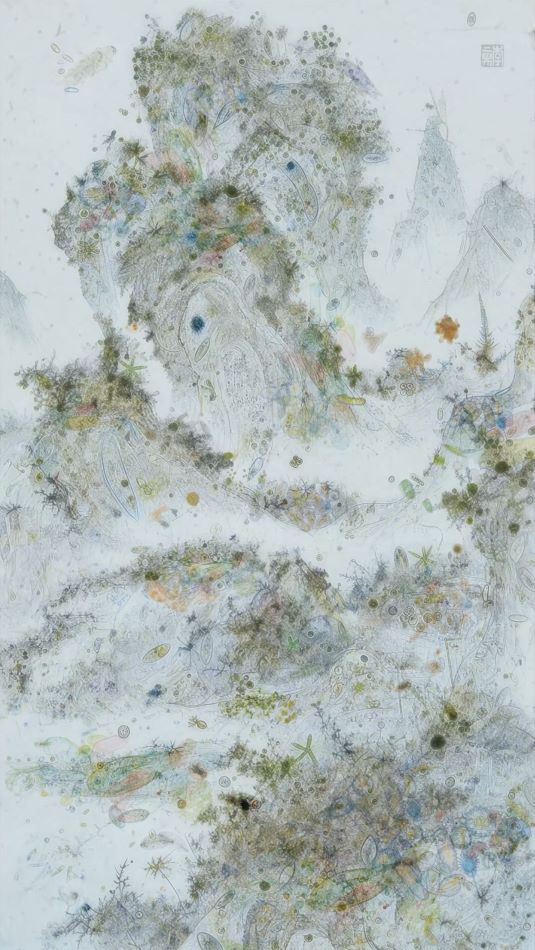
Lee Lee-nam Microscopic Shanshui (Micro-Landscape) - Mountain Villa on a Quiet Day 2026 | Single-channel video, LED Display 75”, 9 min 23 sec | 170.5 × 97.9 cm
The macro and the micro are not separate realms, but rather distinct layers that emerge depending on the scale of observation.
By intersecting traditional painterly icons with microscopic forms, Lee explores the hidden dimension of what is conventionally termed a "landscape." A canvas that appears as mountains and ridges from a distance scatters into traces of individual particles upon closer inspection, revealing contrasting aspects depending on scale and proximity.
The "formlessness" in the exhibition title points directly to this fluid, unfixed state before an object consolidates into a single image.
Likewise, "soundlessness" does not denote absolute silence, but rather the continuous presence of waves beyond the threshold of human hearing.
By acknowledging that reality exists outside the reach of human eyes and ears, the exhibition fractures the anthropocentric view that defines existence solely through the scope of human perception.
Ultimately, Seeing the Formless, Hearing the Soundless extends beyond merely magnifying or visualizing the unseen.
Beginning with a rigorous inquiry into microscopic textures, Lee’s artistic reflection expands into an interconnected network where humans, non-humans, nature, and technology converge, encouraging viewers to step outside their familiar sensory boundaries to embrace existences previously left unnoticed.
Lee Lee-nam is a pioneering media artist who has built a contemporary visual language by bridging traditional painting with digital technology.
Reinterpreting classical masterpieces and landscape imagery through digital media, he continuously explores the intersection of tradition and modernity.
His practice spans video art, media art, large-scale media facades, and public projects, with works exhibited at prominent international museums, biennials, and cultural events.
Born in Damyang, South Korea, Lee graduated with a degree in Sculpture from Chosun University in 1995, where he also earned his Master of Fine Arts in 1997.
He subsequently completed doctoral coursework in Visual Arts at Yonsei University's Graduate School of Communication and in Fine Arts at Chosun University.
His notable exhibitions and projects include Lee Lee-nam’s Shanshui Theater (2025, ACC, Gwangju), Radiant Landscape—Mongolia, Korea (2025, Chinggis Khaan National Museum, Ulaanbaatar), Personal Structures (2015, Venice), a 50th-anniversary performance at the Van Gogh Museum (2023, Amsterdam), and a media facade at the Colosseum in Rome (2025) commemorating the Korea-Italy Cultural Exchange Year.
He has also directed media art for major global sporting ceremonies, collaborated with Google Arts & Culture and Google Gemini, and holds works in major collections including the National Museum of Modern and Contemporary Art, the National Museum of Korea, and the Leeum Museum of Art.
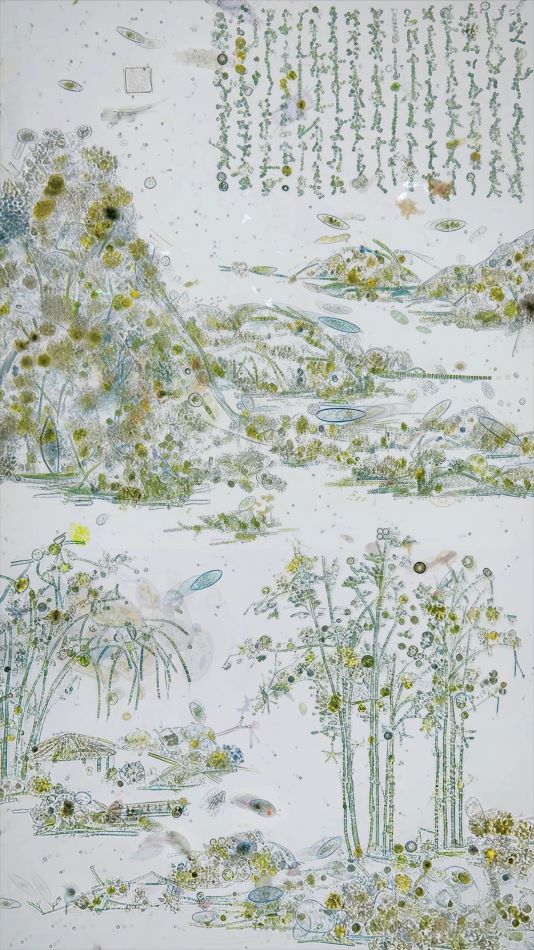
Lee Lee-nam Microscopic Shanshui (Micro-Landscape) - River Pavilion and Mountain Colors 2026 | Single-channel video, LED Display 75”, 9 min 23 sec | 170.5 × 97.9 cm