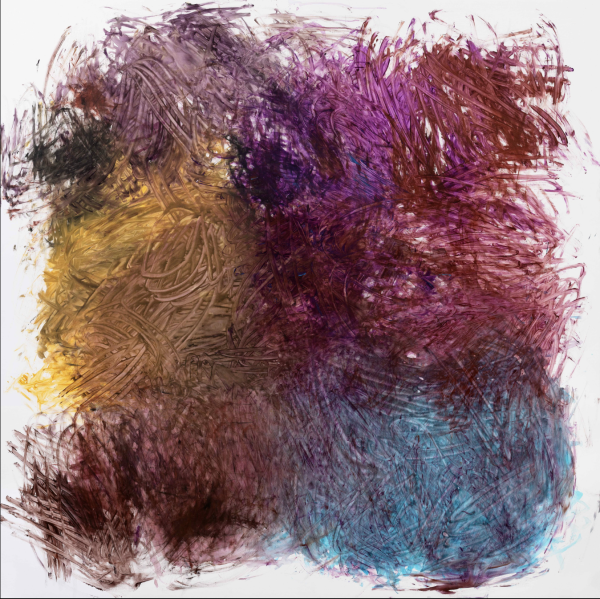
2026
Hematite, Yellow ochre, Cinnabar, Manganese oxide, Acrylic, Canvas
200.0 × 200.0 cm
Whitestone Gallery Beijing presents The Field of Life and Death, a transformative solo exhibition by cross-media artist Dai Ying, on view from June 13 to July 18, 2026.
Comprising eighteen profound canvases, the exhibition brings together a comprehensive survey of the artist’s seminal series, including Geo-Maternal, Goddess, M-Theory, traditional oil works, and her highly anticipated latest collection, Facing Gaia.
Celebrated independent critic and curator Bao Dong notes that Dai Ying’s creative evolution began nearly two decades ago through a delicate yet rigorous experimentation with Xuan paper and raw pigments.
In those early works, layers of color slowly seeped into the fragile, weightless fibers of the paper through an exhausting process of repetitive staining and absorption, giving rise to expanding spiral and elliptical structures.
These revolving geometries transcend simple biological forms—reminiscent of cells, embryos, or maternal anatomy—to mirror the foundational principles of contemporary Superstring Theory, suggesting that the deepest layer of our physical universe is composed of microscopic vibrating strings whose oscillations generate all matter, from stone and light to human flesh.
Within this theoretical framework, Dai Ying constructs the conceptual system of the "Geo-Maternal Matrix," a philosophical position arguing that feminist art must look past the basic pursuit of socio-political rights to initiate a constructive spiritual genesis.
This methodology manifests tangibly in her Geo-Maternal series, which merges traditional Chinese cosmology—wherein the Earth represents a generative feminine womb—with ancient cross-cultural iconography.
Embedded deep within dense strata of mineral paint lies the Egyptian Ankh, the historic key of life and a talisman for traversing the threshold of death.
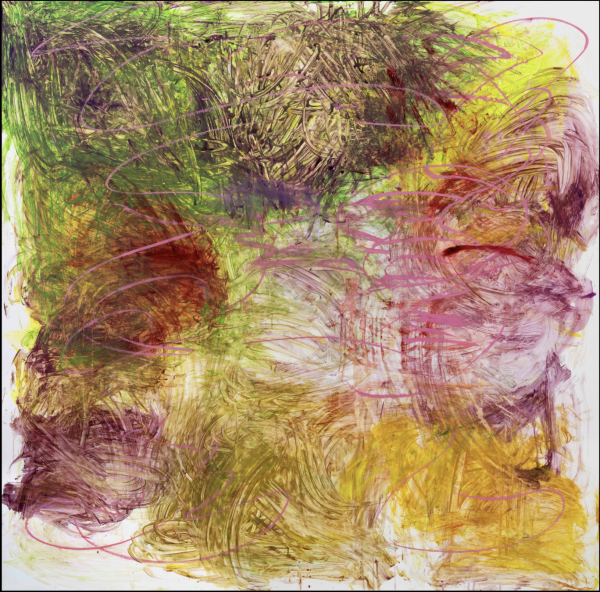
2026
Yellow ochre, Cinnabar, Acrylic, Oil, Canvas
190.0 × 190.0 cm
To build these symbols, the artist utilizes powdered obsidian excavated from Paleolithic sites tens of thousands of years old, an ancient material once weaponized and sacralized by the Shang and Mayan civilizations.
In her most recent Facing Gaia series, Dai Ying has abandoned the paint-brush entirely to immerse her bare hands, palms, and fingers directly into the raw textures of ochres, charcoal blacks, and ground stone.
The resulting marks are visceral claws, scrapes, and bruises upon the canvas, directly reconnecting her practice to prehistoric cave painters who mixed minerals with animal fats to leave permanent marks on stone walls.
In an era where contemporary discourses surrounding womanhood are frequently diluted into empty ideological slogans or packaged as carefully curated commercial lifestyles, Dai Ying's work firmly anchors itself in the heavy reality of lived experience.
She rejects empty identity performance in favor of raw material residues, presenting the physical traumas of childbirth, the quiet void of her father's death, and the ruins of demolished homes as weighty testimonies.
Curator Bao Dong explicitly links this directness to the legendary literary legacy of writer Xiao Hong, whose seminal novel The Field of Life and Death charted the brutal cycles of birth, suffering, and erasure among rural women with an uncompromised, unmediated clarity.
Like Xiao Hong, Dai Ying recognizes that pain needs no ascent into grand abstraction; instead, the most profound aesthetic statements begin with what has been deeply endured.
Born in 1983 in Sichuan and split between Beijing and New York, her early rigorous training in classical calligraphy and ink painting has evolved into a visual logic where energy flows through botanical matrices, bloodlines, and cyclical patterns.
The enduring power of Dai Ying’s practice resides in the instinctual friction between two coexisting emotional states: absolute meditation and untamed ecstasy.
At times, her work emerges from a profound stillness, creating dense, sedimented textures that feel like heavy stones resting at the bottom of a deep well.
Conversely, her process can fracture into a feral, ecstatic frenzy where pigment is violently thrown and the canvas becomes a battlefield of physical struggle.
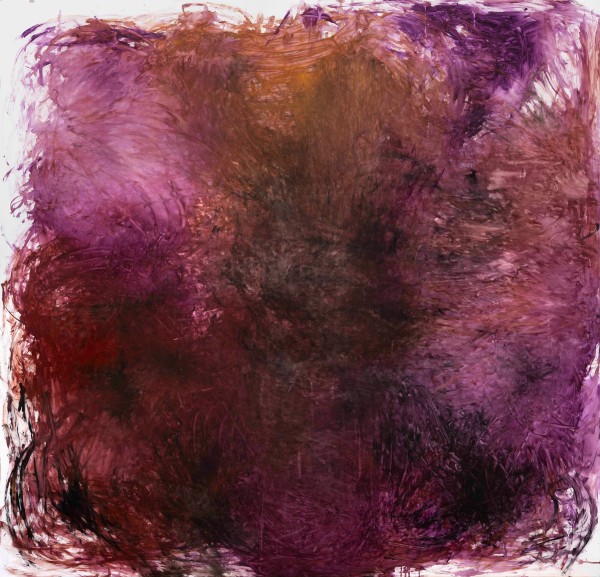
2026
Hematite, Yellow ochre, Cinnabar, Manganese oxide, Acrylic, Canvas
200.0 × 200.0 cm
These dual impulses of quiet contemplation and untamed animal instinct are not opposing paradigms but divergent pathways to the same primal source.
By balancing Eastern spirituality with contemporary Western expression, Dai Ying’s canvases establish an entirely new visual order, offering a compassionate yet fierce testament to an ancient maternal energy that continuously rises from beneath the earth to converse with our modern existence.
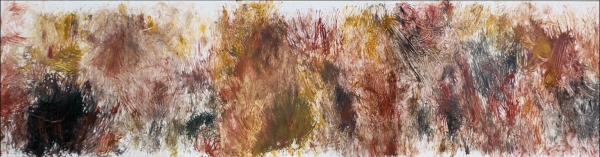
2026
Hematite, Yellow ochre, Charcoal, Manganese oxide, Kaolin, Animal fat, Canvas
210.0 × 860.0 cm